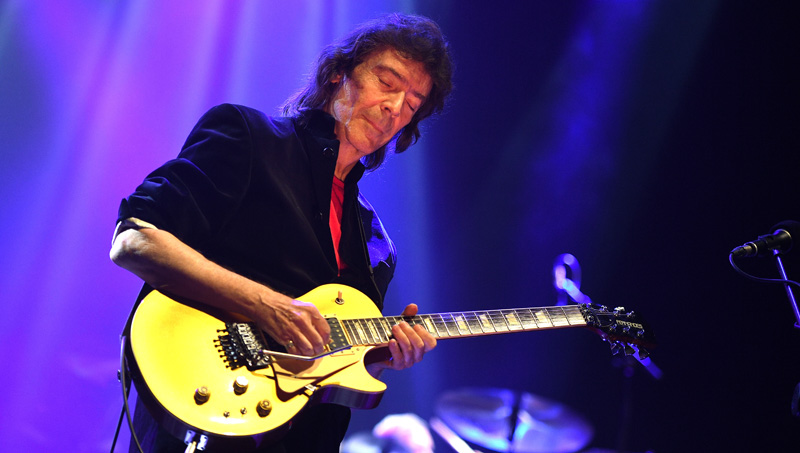
As a member of Genesis (the “first” version), collaborator and prolific solo artist, guitarist Steve Hackett is a certified Prog Rock legend.

He’s also in an interesting place to both celebrate his musical successes of the past 50+ years both in a group and solo while also producing challenging and creative new material. As in this year’s concept album The Circus and the Nightwhale (Inside/Out Music).
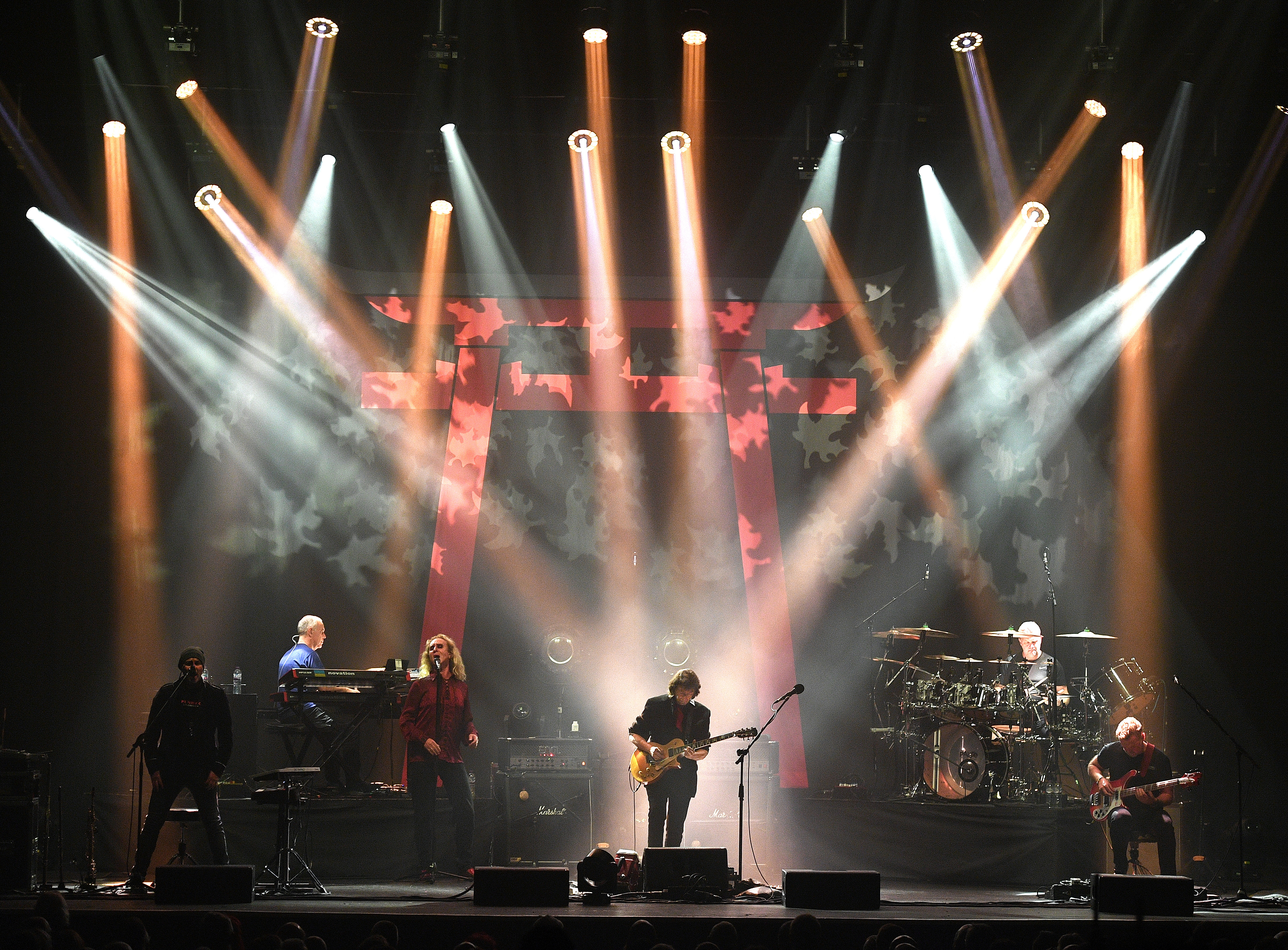
All Sides of Steve get nearly equal time in his current tour. His time on stage will be spent with an opening set of solo highlights (and a few tracks from Circus); a second set playing Genesis’ 1972 record Foxtrot in its entirety (including fan favorite “Supper’s Ready”); and an encore that includes the Genesis song with perhaps his most famous solo (“Firth of Fifth”).
The Steve Hackett Genesis Revisited 2024: Foxtrot at 50 and Hackett Highlights tour is, in essence, the “the best of three worlds” for the 74-year-old.
“The album has done really well in Germany and the UK. So, it seems to not only have legs, its sprouted wings!” Hackett says over the phone. “There is this nostalgic portal at the beginning, and then the story takes off. It’s nice to have options for so much to play on this tour!”
The Circus and the Nightwhale is fairly compact for a concept record, with 13 songs (including some instrumentals) and clocking in at just under 45 minutes. It is just the latest in nearly 30 solo albums he’s released.
In it, Hackett combines both a fantastical tale and his own real-life story. On several, he collaborated in writing with his wife Jo Hackett and/or bandmember Roger King.
“The idea was to do something both autobiographical and metaphorical. I found it very liberating. Sort of like self-commissioning. It’s like a film for the ear,” Hackett says. “And I think framing it with sounds that have the least to do with rock and roll, it’s not what people might expect.” Hackett handles most of the vocals.
In The Circus and the Nightwhale, a man named Travla (a Hackett doppelganger) grows up in a bleak industrial area of England, as Hackett did near the Battersea Power Station (“People of the Smoke”). He encounters both nefarious characters and young love (“Taking You Down” “Found and Lost”) and achieves stardom in music but finds himself controlled and wanting to break out (“Enter the Ring,” “Get Me Out!”).
In a series of interviews he did for YouTube about the making and meaning of the album, he calls “Taking You Down” the most traditional “rock” song. The Englishman adding that it “won’t confuse our Colonial cousins…it’s not too British.” We ask him to, um, elaborate, to his immediate laughter.
“Well, I think it’s a roundabout way to a backhand compliment. So much of British music was initially a spin-off from our American cousins, and then it changed in [Prog]!” he says. “It’s the most traditional rock song on the album.”
In his autobiography, A Genesis in My Bed, (for which I spoke with him), he told more about the real-life childhood Artful Dodger-type friend who inspired the song. And was an ultimate bad influence, even if he helped broaden Hackett’s musical horizons.
The friend eventually had health issues and suffered a heroin overdose. Hackett says has no idea if he’s still alive today, but if he is presumes he’s running some “shady South American corporation.”
Back to the story, Travla/Hackett then finds a passionate new love that comes with complications (“Ghost Moon and Living Love”) but is unable to break free from the circus of life and circumstance (“Circo Inferno”).
The story then takes on a more metaphorical tale involving Travla’s Jonah-like ingestion by a whale and his battle to defeat all enemies to bathe in the true light of his new life and love.
Going back, Steve Hackett joined Genesis in 1971 after placing an ad looking for a music gig. Said ad was answered by that band’s vocalist, Peter Gabriel, who just happened to be looking for a new guitarist to join himself, Mike Rutherford (bass), Tony Banks (keyboards) and an outgoing Phil Collins (drums).
Over much of the decade Genesis became a cornerstone of Prog Rock with deep and multi-layered albums like Foxtrot, Selling England by the Pound, A Trick of the Tail, and The Lamb Lies Down on Broadway.
Feeling a bit trapped and creatively stifled (Hackett wanted to pursue a concurrent solo career, which was not encouraged), he left the group in 1977, by which time Gabriel has also departed. The band moved Collins up to lead vocals and pursued a more rock/pop sound while scoring massive radio and video hits in the ‘80s and ‘90s.
And Hackett—like a lot of rock journalists—know there is a deep schism in the fans who prefer each version.
“There is the albums band of the ‘70s and then the post-MTV approved version of Genesis with the singles. But they’ve each got something to say to listeners. They’re two bites of the same cherry!” he offers. “Fans tend to be fans of one or the other [version] of Genesis, but not both!”
The band was inducted into the Rock and Roll Hall of Fame in 2010 but did not perform. There had been talks about reuniting the “classic five” for a tour or recording project, but it always fell through whether due to the reluctance of one of the quintet or scheduling issues.
The last time they were all in the same room was in 2014 for a photo shoot to promote a band documentary. Hackett and Gabriel were invited to attend the last show of the Genesis farewell tour in London on March 26, 2022—by which time an ailing Collins had given up drum duties and was struggling to sing seated in a chair onstage. Hackett was on tour and couldn’t make it, while Gabriel did but did not go onstage.
As for the Foxtrot portion of the show, Hackett says it—along with Selling England by the Pound—were his favorite Genesis record to be involved in, adding that it was he who mainly pushed the band to experiment with multi-suite/portion songs like “Supper’s Ready.”
“That song also took people on a journey, an odyssey. It’s like one song with a number of subheadings,” he says. Hackett is also aware that Prog guitar players are often looked at with a much closer microscope by guitar nerds and tech geeks than a “regular” rock player. It was something recently expressed to this writer by longtime Jethro Tull guitarist Martin Barre.
“I know Martin and we talk from time to time! There’s an analytical [portion] to it, and they’re detail freaks. [Prog] is more of a niche market. The fans don’t get bored trying to figure out what vintage screw was used in this old fuzzbox!” Hackett offers.
“The interesting thing about Tull in the ‘70s is they had a lot of dynamics. It would be acoustic and burst into something different. I asked Martin how he got that sound and he said “just a Les Paul guitar straight into a Marshall amp!’”
Hackett’s band for the current tour includes Roger King (keyboards), Rob Townsend (sax/flute/vocals), Nad Sylvan (vocals/tambourine), Jonas Reingold (bass) and Craig Blundell (drums).
Finally, as to what Foxtrot means to him in the wider sense of his discography, Hackett says he’s had “years” to reflect on it.
“The years of Foxtrot and Selling England by the Pound have a seminal appeal. There’s not a weak part on either album,” he believes. “Even John Lennon loved them and was telling people he thought we were the ‘true sons of the Beatles.’ And that’s better to me than what any critic has ever said. It was priceless!”
For more on Steve Hackett, visit HackettSongs.com
This article originally appeared at HoustonPress.com


 Classic Rock Bob