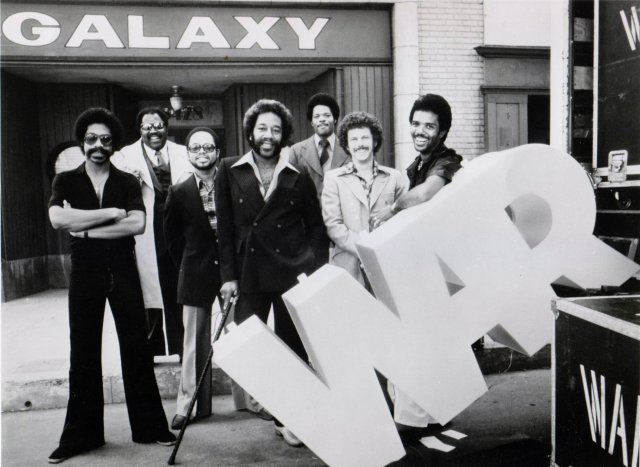
MCA Records Publicity Photo, 1977
Three and a half years in the making, my first book, Slippin’ Out of Darkness: The Story of WAR is out today!
Order it or find out more info HERE.
MCA Records Publicity Photo, 1977
Three and a half years in the making, my first book, Slippin’ Out of Darkness: The Story of WAR is out today!
Order it or find out more info HERE.
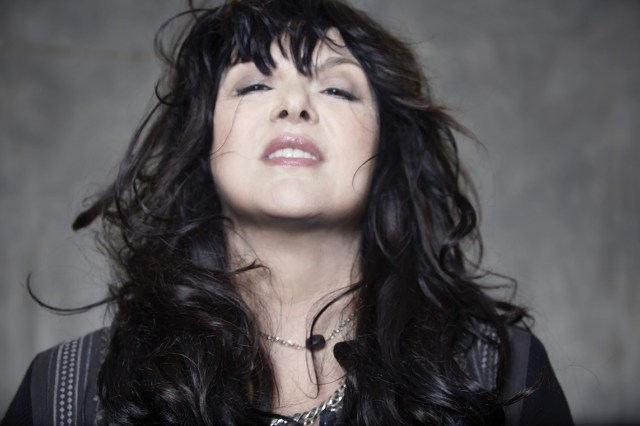
Ann Wilson today. (Photo courtesy of MSO PR)
More than four decades into her career as one of rock’s premier and most distinctive vocalists, Ann Wilson recently wrapped up she’s never attempted before: an extended solo tour.
“We have a very lean, mean band, nothing extra. Great musicians that can go big or gentle, and a full video program for the whole two hour show,” she says enthusiastically. Of course, her main gig since the mid-‘70s has been co-leading the band Heart with sister/guitarist/co-writer Nancy (sidetrips with the Lovemongers and The Ann Wilson Thing! Notwithstanding).

Photo by Jess Griffin/Courtesy of MSO PR
Inducted into the Rock and Roll Hall of Fame in 2013, Heart racked up an instantly recognizable string of hard rock hits in the ‘70s (“Crazy on You,” “Barracuda,” “Magic Man,” “Straight On”) and enjoyed even greater success in the ‘80s with anthemic power ballads (“What About Love?” “Never” “These Dreams,” “Alone”).
But – as even non-Heart fans know by now – plans for both Ann’s solo tour and Nancy’s new group, Roadcase Royale, weren’t exactly percolating a little over a year ago, or even thought about. That’s because in one of the most jarring recent music stories, at the moment the Wilson sisters are estranged – very estranged.
In a nutshell, there was an incident last year at a show involving a tour bus, a dog, and an intense physical altercation between Ann’s new husband and Nancy’s twin 16-year-old boys. It opened a gaping rift between the siblings usually thought of as perhaps the closest personally and professionally in all of music.
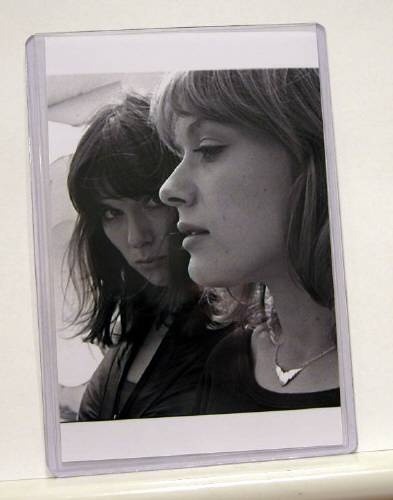
Ann and Nancy Wilson in the ’70s (www.heart-music.com
Some month ago, Rolling Stone did a comprehensive piece on the incident and its aftermath, tellingly telling the magazine that the group was no longer on a “temporary hiatus,” but an all-out “hiatus.”
Still, there is one positive outcome, and that Ann agrees it has forced both sisters to step outside of their boxes with their current projects
“We are definitely out of our comfort zone and for me, it’s fantastic fresh, and liberating. I can’t say anything negative about it – except for the money!” Wilson says. “But it’s really good for me, and I’m sure for Nancy.”
Surprisingly, a gander at Ann Wilson’s current set lists show less than 25% are Heart songs – and they are “reimagined.” The rest includes new original tunes written in the last year and covers, a lot of covers.
Mainly from her own personal music faves like the Who (“Won’t Get Fooled Again”), Jimi Hendrix (“Manic Depression”), the Animals (“We Gotta Get Out of This Place”), Yes (“I’ve Seen All Good People”), Elvis Presley (“One Night”), Aretha Franklin (“Ain’t No Way”), and even the Black Crowes (“She Talks to Angels” – the lyrics of which she says she “really identifies” with).
But there’s nothing it seems from Ann Wilson’s biggest rock heroes – Led Zeppelin – a group for which she has been known to cover a song or two or three over the years.
“What I liked about them at first was Robert Plant,” she offers. “I had never seen a singer before who could be just as much female as male. It was a beautiful thing, very poetic. I thought I could sing that stuff, and I could.”
Perhaps the ultimate fangirl moment was when Ann and Nancy were chosen to perform ultimate Zep tune “Stairway to Heaven” in front of the surviving members themselves and a star-studded audience in 2013 when the band received their Kennedy Center Honors.
Beginning with just Ann’s voice and Nancy’s acoustic guitar, as the tune progresses they are eventually joined by a full band (including Zep progeny Jason Bonham on drums), an orchestra, a vocal ensemble, and then a whole damn full gospel choir.
“We couldn’t really see them from the stage, but it was pretty nerve-wracking. I mean, in addition to Led Zeppelin, you had President Obama and the first lady, Dustin Hoffman, and Stephen Colbert!” she says. “It was a very intense, famous audience.”
Portions of this article originally appeared on The Houston Press.
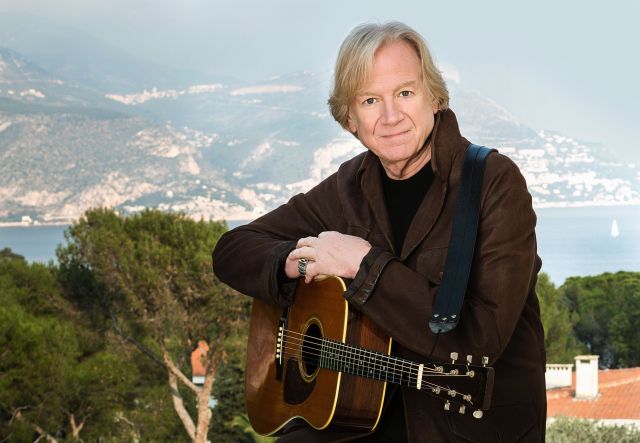
Photo by Marta Szczesniak/Courtesy of Eagle Rock
Of all the hits that the Moody Blues have charted over the past 50+ years of existence, the one big calling card for the English band is probably “Nights in White Satin.” Atmospheric, classically orchestrated, mysterious, and featuring dreamy vocals by Justin Hayward, it’s not just a hit, but a classic rock anthem.
Amazingly, it wasn’t until recently that the singer and writer of the said 1967 tune really “got” it – despite that fact that he’s been performing it for decades.
“I was 19 going on 20 when I wrote it, and I had no idea what it was really about. I was at the end of one big love affair and starting another, and it was not meant to be a single,” Hayward says. “It was the opposite of what a single should be!”
And sure, what kind of pop hit has a spoken word poem (written by drummer Graeme Edge and recited by keyboardist Mike Pinder) smack dab in the middle? But then, Hayward opened his email one day and someone had sent him the 2010 cover version done by soul singer Bettye Lavette. And his entire world view changed.
“For the first time in my life, I understood the song, what it was supposed to be. Her version explained it,” Hayward says, his voice brimming with enthusiasm. “I have been singing it from the heart for a long time and every word meant something, but I hadn’t understood it because it was a collection of random thoughts. But the way she did it, it made sense. And I have the feeling that her version is better than ours!”
Hayward says it “touched his heart” that he later got an email from Lavette that read “Hello baby. Thanks for the song.”
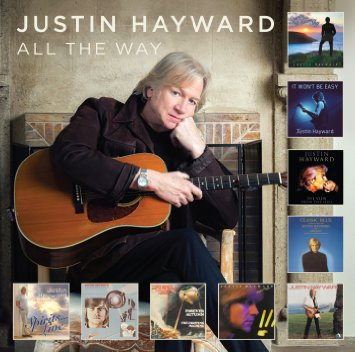
On this solo tour, he’ll undoubtedly perform “Nights” and some other Moody Blues classics (which also include “Tuesday Afternoon,” “Question,” “The Voice,” “I’m Just a Singer [In a Rock and Roll Band],””Ride My See-Saw,” and “Your Wildest Dreams”). But he’ll also dig into his surprisingly deep solo catalog, the best of which have been compiled into the CD All the Way (it also includes one new tune, “The Wind of Heaven”).
Most of this material is more quiet and introspective than his Moodies songs. On his recent solo tour, Hayward was accompanied onstage only by only Mike Dawes (guitar) and Julie Regins (keyboards/vocals).
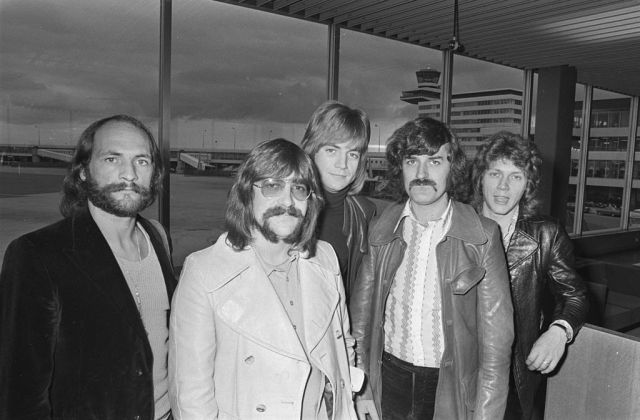
The Moody Blues arrive at Schipol Airport, The Netherlands, 1970: Mike Pinder, Graeme Edge, Justin Hayward, Ray Thomas, John Lodge. Photo by Clausule/Wiki Commons
“Over the years, I held a few things back from the Moodies that I thought were too personal or particular. Too much ‘me, me, me’ instead of ‘us, us, us.’” Hayward says. “And that represented some kind of pain or psychological dilemma in my life that needed to be expressed. I do things [on this tour] that don’t work inside the loud context of the Moody Blues.”
Leading off the CD is the original version of “Blue Guitar.” And while it later appeared on record in a different, highly-orchestrated version, this is the original mix done with members of 10cc. Long thought lost, it was recently located in a tape storage unit.
“I was overjoyed to find that. I knew it was good, in the original form and mix. But the record company didn’t want to credit 10cc, who weren’t on their label at the time,” Hayward explains. “So [10cc member] Graham Gouldman and I went to try and find that original Eric Stewart [also in 10cc] mix. It was unadulterated, clear, and brilliant.”
Hayward also cops to a bit of male musical bonding with Alberto Parodi, who mastered the track. “We sat like silly old men and held each other’s hands during the playback,” the singer notes. “Then again, he is Italian. And they are very emotional.”
Also on the CD is Hayward’s biggest solo hit, the enchanting “Forever Autumn.” While not written by Hayward, it was done for the 1978 concept album Jeff Wayne’s Musical Version of the War of the Worlds. Though – as the singer explains in the liner notes – after he recorded it, he heard nothing more for a year, until he was informed by a record promotion man that it would be the single off the album! Hayward would reprise his version on several tours staging the story.
“Honestly, I had forgotten all about it. I did the song and we had a lovely day and then Jeff Wayne asked me back for another song and some backing vocals,” he says. When I tell Hayward that – as a 9-year-old – I was obsessed with the song and played my 45 single endless times, he’s momentarily speechless.
“That is really incredible you said that. Because after I recorded it, I went home and my wife heard it, and she said ‘What’s that all about? Who’s going to buy that?’ and I said ‘I don’t know, probably 9-year-old boys.’ So Bob, I finally met you!”
In the MTV era of the ‘80s, the Moody Blues had (like fellow ‘60s prog rockers Yes) something of a resurgence on the heels of much-played videos. In the case of the Moody Blues “Your Wildest Dreams” and “I Know You’re Out There Somewhere.”
The first clip shows the story of an English girl in the ‘60s who follows the “young” Moody Blues (actually actors) and then, years later, encounters the “current” band at a show.
“Well, we had to do that. We were about 45 at the time, so we weren’t going to play younger versions of ourselves!” Hayward laughs.
“But I would have to say that was the happiest time that the group has had and in my life as well. I was straight and fully conscious and made sure I enjoyed every moment. And to have a hit record in the American charts and Germany and people recognize you from the video…that was great. But it lasts about three weeks and people move on!”
After the current solo tour winds up, there will be more activity with the Moody Blues, who also host their own cruise. But as with any band with a 50+ year (or even much less) history, there’s some drop off in membership.
The current version of the Moody Blues includes original drummer Graeme Edge, and classic lineup members Hayward and bassist John Lodge. When I spoke with Edge in 2011 he said that the band could not exist without the utterly distinctive vocals of Hayward, though the man who owns those pipes in question disagrees.
“Well…there’s always another kid that can come along and do those songs. Graeme and I love each other dearly, but I’ve seen so many bands where they got a new guy singing and just carried on!” he says.
Finally, the Moody Blues are usually on a short list of acts that are not currently in a certain Cleveland-based Hall of Fame, but many feel should be. And with the inclusion of more classic and prog rock bands in recent years (Chicago, Yes, Electric Light Orchestra, Deep Purple), might it be time for the Moody Blues?
“I don’t’ care,” Hayward offers. “It doesn’t mean anything in my life, but it does to the American fans. In Europe, it doesn’t even make it to the news channel. But it must be tough for the fans. I hope it happens for them one day.”
Portions of this interview originally appeared in The Houston Press.
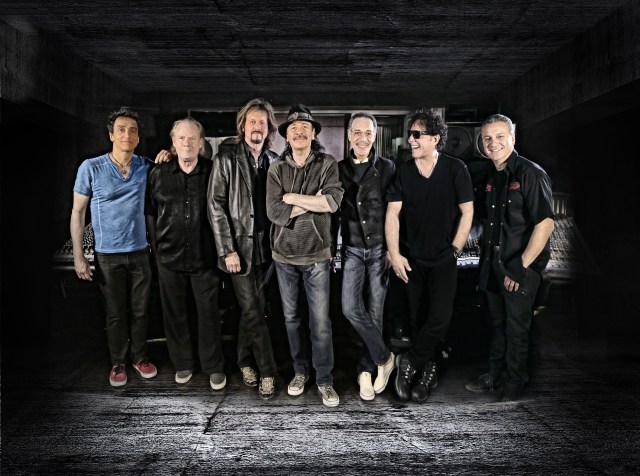
The boys in the reconstituted Santana: Benny Rietveld (bass), Michael Shrieve (drums), Gregg Rolie (lead vocals/keyboards), Carlos Santana (lead guitar), Michael Carabello (percussion/vocals), Neal Schon (guitar) and Karl Perazzo (timbales/vocals). Courtesy of Jensen Communications.
On the day of Prince’s death last year, television was awash in old interviews, concert clips, and videos. During a 1999 chat with Larry King on CNN, the Purple One talked specifically about three of his biggest musical influences: Stevie Wonder, Graham Central Station, and Santana.
The next day, founding member, singer/keyboardist Gregg Rolie (whose pipes feature on signature hits “Black Magic Woman,” “Evil Ways,” and “Oye Como Va”) reflected on that connection.
“Prince has told Carlos that Santana was the band for him, and had a lot of influence on his sound. And you can hear it,” Rolie offers. “What’s kind of bizarre is that I heard he went out shopping for music just before his death [at Minneapolis’ Electric Fetus record store], and one of the new albums he bought was Santana IV.”
Wait, hasn’t Santana put out a billion records since their self-titled 1969 debut with the black and white psychedelic lion on the cover? Well, yes. But for this project, guitarist/leader Carlos Santana has reassembled most of the Woodstock-era lineup featured on those first three seminal records Santana, Abraxas, and Santana III.
That includes Santana, Rolie, guitarist Neal Schon, drummer Michael Shrieve, and congist/percussionist/singer Michael Carabello. Bassist Benny Rietveld and timbalist/percussionist Karl Perazzo from the group’s regular current incarnation fill out the lineup.
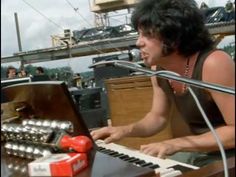
Gregg Rolie onstage at Woodstock, 1969. Photo from http://www.greggrolie.com
So titling the new effort Santana IV is simply a continuation, as if this band of brothers was just picking up 45 years later (though Rolie and Schon would go on to co-found another little group that did OK for itself, Journey). And it seems that Schon was the real kickstarter for this campaign.
“He really pushed for it and Carlos wanted to do it. And when just the five us got together for the first time, we jammed for six or seven hours,” Rolie says. “And we had the same magic between the players, and we knew it was going to be great. And we really played with each other. It was perfectly imperfect”
Rolie says the band worked on more than 40 pieces of music – some fragments, some completed songs, some jams – before settling on the 14 tracks which make up Santana IV. And all were recorded in two or three takes.
It’s a powerful, incredible record that is far better than most people might suspect, combining all of the band’s classic sonic elements and Latin influences (“Yambu,” “Caminado,” “Suenos”) on instrumentals (“Fillmore East”), rock epics (“Blues Magic/Echizo,” “Come As You Are”), and more commercial sounding tunes (first single “Anywhere You Want to Go,” “Shake It”).
Two tracks – “Love Makes the World Go Round” and “Freedom in Your Mind” feature Ronald Isley of the Isley Brothers on lead vocals in the social/political-themed tunes. Someone that Rolie was happy to cede the mike to.
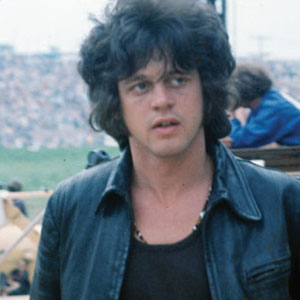
Gregg Rolie onstage at Woodstock, 1969. Photo from http://www.greggrolie.com
“He’s a musical icon and I listened to him as a kid. He’s such a gentle man. And he still has the pipes!” Rolie says, adding that Isley joined the Santana IV lineup for a live show that was filmed for DVD release.
“Among the band, we have the same sensibility about playing music,” he adds. “The time seems like it never passed.”
Not part of the reunion for various reasons were members of the same era Jose “Chepito” Areas (timbales/congas/percussion), and Marcus Malone (drums). The latter made national news when he was discovered in late 2013 by a TV reporter living homeless on the streets of San Francisco. He later had an emotional reunion with Santana caught on video.
“Marcus…it just didn’t happen. And Carlos has been playing with Karl for 20 years on timbales,” Rolie offers. And bassist David Brown died in 2000.
So with a great classic band reunited and able to play a rich back catalogue with strong new songs, it would seem like a tour would be imminent. However, a full tour isn’t up for discussion. Carlos Santana has been active his current band, Schon is embarking on massive Journey tour, and Rolie s handling double duty on stage with both his own group and as part of Ringo Starr’s All-Starr Band, who are touring this fall. Both Rolie and Schon, are of last month, are both two-time indcutees into the Rock and Roll Hall of Fame.
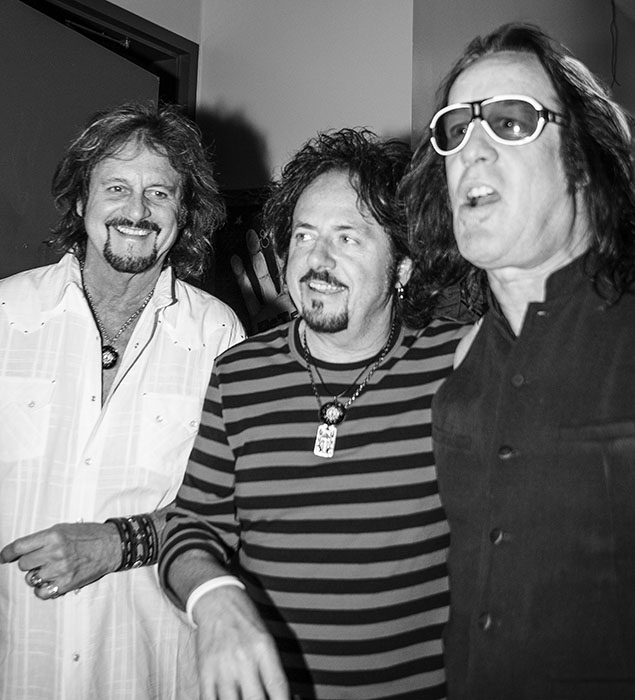
With Ringo’s other group: Gregg Rolie, Steve Lukather (Toto), and Todd Rundgren. Photo from http://www.greggrolie.com
“It’s a chess game with all the schedules and making them work. But this lineup will have and will do some more [one-off] shows,” Rolie says. “I think the way we make this work in the future is to do a Santana/Journey tour.”
Concerning his continued employment as an All-Starr, sometimes he still has to pinch himself that he’s onstage with a friggin’ Beatle.
“It took me two years to not go “wow, holy crap I’m on the same stage as Ringo Starr!’ I mean, the Beatles, everybody wanted to be in that band. And to be on the same stage as the same guy who helped me get started on all this…it’s incredible, Rolie says. “He’s such a good man and good bandleader and we all get along famously.”
Today, Rolie is a resident of Austin, and enthuses about life in the Lone Star State at his home overlooking Lake Travis. But with touring commitments to three bands (and work on a solo record that was temporarily shelved for Santana IV), he only has one question.
“I wonder…what the hell happened to my retirement!”
Portions of this article originally appeared in The Houston Press.
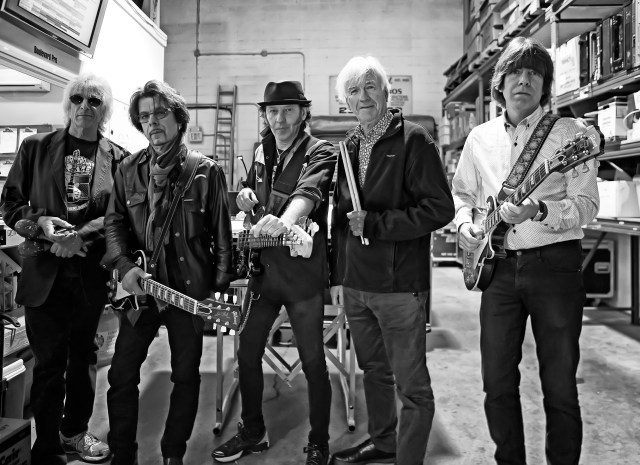
Your current Yardbirds: Myke Scavone, Johnny A, Kenny Aaronson, original member Jim McCarty, and John Idan. Photo by Arnie Goodman/Courtesy of Kayos Productions.
Coming out of the suburbs of London in 1963, the quintessentially English Yardbirds had one of the more interesting career trajectories of bands in terms of sound.
They hatched as a mostly hardcore blues-based group, specializing in covers like “Good Morning, Little Schoolgirl” “Got Love If You Want It,” and “Train Kept a’ Rollin’” But the band later found their greatest commercial success with more rock and psychedelic numbers like “For Your Love,” “Heart Full of Soul,” “Shapes of Things,” and “Over Under Sideways Down.”
Of course, the band was also an amazing incubator for guitar heroes, having the Holy Trinity of Eric Clapton, Jeff Beck, and Jimmy Page pass through their ranks (not so lucky, original lineup member Anthony “Top” Topham). The rest of the group included Keith Relf (vocals/harmonica), Chris Dreja (rhythm guitar), Paul Samwell-Smith (bass through 1966), and Jim McCarty (drums).
They called it quits in 1968, with only Page left and briefly fronting “The New Yardbirds” before changing that name to…Led Zeppelin. Some members reunited from 1982-83 (In 1976, Relf was electrocuted and died while playing guitar in his basement), and the group has been back full time since 1992. So what’s the biggest difference between the Yardbirds of Yore and the flock in 2016?
“Well…they’re all American now. And they’re younger!” McCarty – the sole original member left – laughs. “But we did a tour last fall that worked really well. And this lineup has a lot of experience, they’ve all grown up with the music, so it’s sort of in their blood.”
The lineup includes several crack players who have also performed with other big names, including guitarist Johnny A (Peter Wolf), bassist Kenny Aaronson (Bob Dylan, Billy Idol), singer/harmonica player Myke Scavone (Ram Jam), and guitarist-singer John Idan.
When the Yardbirds were starting out they – like their contemporaries the Beatles, Rolling Stones, Who, Kinks, Animals, and Zombies – fell under the spell of American blues artists. And a large chunk of their set list included cover tunes by Muddy Waters, Howlin’ Wolf, Elmore James, and Sonny Boy Williamson in addition to their own originals.
McCarty says it’s easy to figure out why that particular music didn’t have anything near the impact on U.S. teens as it did the young lads Across the Pond.
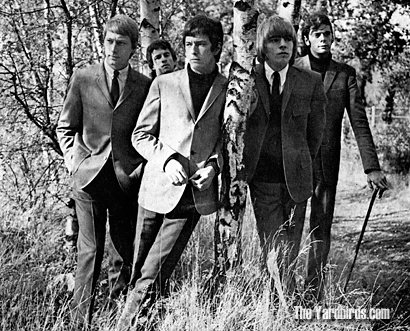
The Early ‘Birds: Chris Dreja, Jim McCarty, Eric Clapton, Keith Relf, and Paul Samwell-Smith.
“Most of that music was on a black circuit, wasn’t it? Those performers played to black audiences, and not really white kids in the U.S. They really didn’t know about it until the Stones and the Kinks started playing those songs,” he offers. “And you really just had like a half a dozen U.S. albums that all [us] bands got their material from, like Howlin’ Wolf and Slim Harpo and Chuck Berry.”
A fan of more rock-oriented artists like Buddy Holly and Johnny Cash, McCarty nonetheless grew to love the “bluesier stuff,” which he says added elements of soul and raw emotion. “And when that music started coming over to England in the early ‘60s, it was kind of underground,” he recalls. “You wouldn’t hear it on the radio, you’d have to go to a particular record shop to find it.”
Musicians would also trade notes in person – often during late night bull sessions at London clubs like the Bag O’Nails, the Marquee, and Ronnie Scott’s Jazz Club. It wasn’t uncommon to find members of top groups drinking, mingling, and with an eye out for a different sort of ‘Bird.
“You’d meet in a late club because that’s the only time you weren’t working, though not all of us lived in the city,” McCarty says. “I’d go to the Speakeasy and Bag O’Nails and Cromwellian, and you’d see John Lennon or Keith Moon or some of the Kinks. Or you’d see them on the motorway stops along the way for a cup of tea or something!”
As the man who kept the beat behind three of rock’s most well-known axe men, McCarty had ample opportunity to observe their very different approaches to recording and performing.
“Of course they were all great. As for playing with me, I supposed that Jeff was the most off-the-wall, the most spontaneous. You never knew how he was going to play. He might have a great night one night and a bad one the next, depending on what mood he was in!” McCarty laughs.
“The other two were much more stable. Jimmy was used to playing on sessions for people, so he was very professional. And Eric was just learning how to play, really, to play great blues. He was a purist [at that time], and he really wasn’t going to expand himself.”
And as to the rock legend that Clapton played only begrudgingly on the more pop-oriented “For Your Love” – then promptly quit the band when it became their first hit?
“Yes, that’s true. But a blues song wasn’t going to put us [on the charts],” he offers. “And there were also various politics in the band. Eric and Paul really didn’t get on, which was a bit of a problem.”
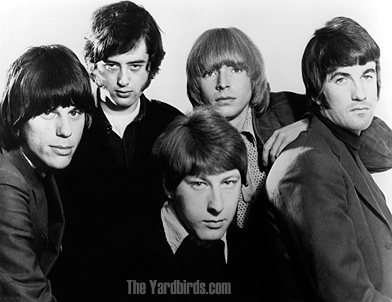
Later ‘Birds with TWO guitar gods: Jeff Beck, Jimmy Page, Chris Dreja (bottom), Keith Relf, and Jim McCarty
In 1992, the same year that the Yardbirds started up again, the group (minus Topham) was inducted into the Rock and Roll Hall of Fame, with U2’s the Edge handling the induction honors. McCarty recalls a “wonderful, great evening,” topped by the fact that he got to meet boyhood idol Johnny Cash.
Today, the Yardbirds are busy with summer and fall U.S. tours, along with a stint of dates in Japan. McCarty is also working on a solo record (the Yardbirds’ last effort was 2003’s Birdland), and writing his autobiography.
He says that he still keeps in touch with Chris Dreja, who left the lineup for good in 2013 due to health reasons. “He seems OK, he’s getting by, but taking things slow. But he can’t really play or get around too much.”
McCarty does mention that the pair did share an interesting memory of touring Texas in the 1960’s, one that nearly took them to the center of a important American historical event.
“We were in a limo coming from the airport with the promoter, and he asked us if we wanted to see the place where Kennedy was shot. It was the first thing he said!” McCarty laughs. “That spooked us a bit, so we said ‘No, just take us to the hotel!”
A version of this interview originally appeared in The Houston Press.
One of the more egregious omissions from the Rock and Roll Hall of Fame (now that Chicago, Yes, ELO, and Journey are in) has got to be Bad Company. Here’s an interview I did with lead singer Paul Rodgers last year just prior to their most recent tour about the band’s legacy, reformations, and that little ol‘ pyramid in Cleveland…
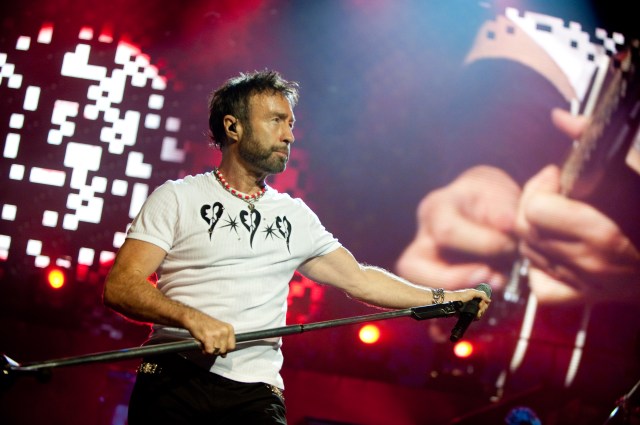
Paul Rodgers today (courtesy of PaulRodgers.com)
Fans of heavy ‘70s rockers Bad Company were undoubtedly thrilled by the recent announcement that the three surviving members — Paul Rodgers (vocals), Mick Ralphs (guitar) and Simon Kirke (drums) — would be re-forming under the name for a co-headlining summer tour with Joe Walsh. Bassist Boz Burrell died in 2006.
But it was with understandable head-scratching when two weeks later, Ralphs announced that he would indeed not cross the pond to the U.S. for the trek, claiming he was “just not feeling up for” the extensive travel. Instead, Black Crowes co-founding guitarist Rich Robinson was announced in his stead.
The turn of events came as a surprise – especially to Ralphs’ bandmates.
“Well…we were all gobsmacked the day after we announced the tour, Mick announced he wasn’t going to do it! It left us in a tricky position, but the show must go on. Though it would have been nice to know ahead of time!” Rodgers says.
“But Mick was very apologetic,” continues the singer. “He said he took one look at the schedule and said he couldn’t do it. And I understand. The travel is grueling. We love being onstage, but the getting there, and the other 23 hours, that can be tough.”
Rodgers says that as soon as he heard about it, he thought Robinson would make a great replacement, having met and played with him at a Jimmy Page tribute at Paul Allen’s Experience Music Project.
“I said we should do something together sometime. Little did I know how soon that would be!” Rodgers laughs. “But I think it will be an interesting energy.”
The rest of the band this tour will also include former Heart member and Rock and Roll Hall of Famer Howard Leese (guitar) and Todd Ronning (bass), both longtime members of Rodgers’s solo group.
And while the five will woodshed on playing the must-play Bad Company tunes like “Can’t Get Enough,” “Feel Like Makin’ Love,” “Rock ‘n’ Roll Fantasy,” “Seagull” and – of course – “Bad Company,” Rodgers says he hopes to dig a bit deeper into the catalog on this tour with tracks like “Man Needs Woman” and “Leaving You.”
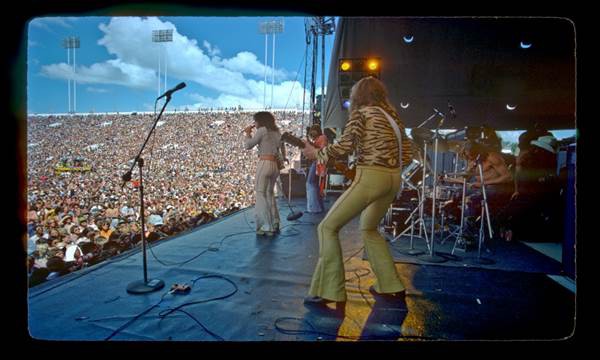
Bad Company live onstage in 1977. Photo by Carl Dunn/Courtesy of Rhino Records.
Those deeper cuts just happen to be captured on the recent new double discBad Company – Live 1977 & 1979. The first CD captures the band’s May 23, 1977, show at the Summit here in Houston, and the second a March 9, 1979, gig in London (with one additional track from a June 26, 1979, show in Washington, D.C.).
Amazingly, this is the first official live release ever from Bad Company, coming on the heels of reissued/remastered/expanded versions of their studio records.
Rodgers says that Rhino Records picked the gigs and sent them to him for approval. “I do remember that Houston show…what a great crowd,” he offers. “But even I can’t believe it’s our first live record. We just never took the trouble to do it! I always said we should be recording and filming things back then!”
Promising that some familiar songs will have slightly different arrangements, Rodgers adds that he wants to take some tunes to a “different place.”
“You always play the bones of the song, but there’s an opportunity live to take it somewhere else,” he says. “And that’s the beauty of music and the relationship between band members and the audience.”
When not occasionally reconvening Bad Company (or, years ago, fronting Paul Rodgers + Queen), Rodgers has a busy solo schedule. His last record was 2014’s The Royal Sessions, which featured ten handpicked blues and soul cover songs like “I Thank You,” “I’ve Been Loving You Too Long (To Stop Now),” “That’s How Strong My Love Is” and “Born Under a Bad Sign” at Memphis’s historic Royal Studios.
And while a lifelong fan of blues and soul, Rodgers does not see what he does with Bad Company (or, previously, with Free) as all that different. “I see rock as a soulful genre. That’s what I want to infuse into it; that’s what’s there for me. I like to do soul music in a rock fashion,” he says – before referencing a contribution from his temporary guitarist.
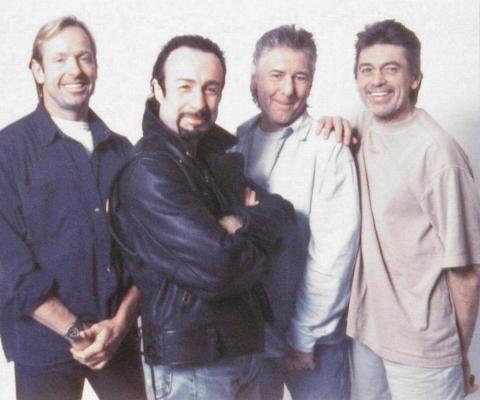
Bad Company at the time of their 1993 reunion: Simon Kirke, Paul Rodgers, Mick Ralphs, and Boz Burrell. Courtesy of Elektra Records.
“When I heard the Black Crowes do ‘Hard to Handle,’ that was it. As long as it has feel and touches you whether it’s blues or soul or rock and roll…that’s what I’m looking for. If it’s cool and it swings and it’s got a groove.”
To that end, Rodgers is itching to get out and play live, which he likens to running a race in sports in that you get “one shot” to achieve what you want to and there are no redos.
For this tour, subtitled “One Hell of a Night,” Bad Company is paired with Joe Walsh, whose offhand comment named the tour. Rodgers says that he and Bad Company have shared co-headlining bills with other classic-rock acts like the Doobie Brothers and Lynyrd Skynyrd, and they’ve always worked out great.
I met Joe back when he was with the James Gang,” Rodgers recalls. “We were at a party together having a drink, and Joe told me that he was tired of the music business and wanted to go to the country and just sit back. But he said he’s been asked by the Eagles to join, and did I hear of them? And I said I did and they were a good band. Next thing I heard, he had joined the band!”
After this tour ends, Rodgers says, he is working with some collaborators and has “written a lot of songs,” but doesn’t want to tip his hand to the project specifics. He will also continue to work with his solo group, and would consider writing his memoirs if he could “just sit on a beach in Hawaii and talk to a tape recorder.”
Finally, there is legacy to consider. For while this year’s inductees into the Rock and Roll Hall of Fame included some long-overdue classic rock acts, Bad Company is on a short list others who should be enshrined (along with Yes, the Doobie Brothers, Journey, Electric Light Orchestra, The Cars, Moody Blues, Jethro Tull…)
And while the voice of Bad Company first dismissed the notion, he’s come around.
“Ahmet Ertegun used to come to dinner at my house when he was helping to [start the Hall] and talked about Bad Company being in,” Rodgers says. “I told him that I thought this was rock and roll and I didn’t want to be in any museum!” Rodgers laughs. “Now, I have changed my mind. It would be nice to be in it!”
This article originally appeared in The Houston Press.
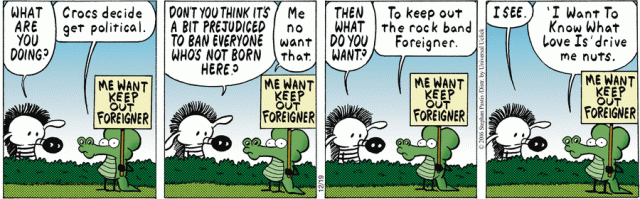
As always, Stephan Pastis, creator of my favorite comic strip, “Pearls Before Swine” gives us a wry comment on classic rock. But does this mean that foreign governments will move to keep out Boston, Kansas, Chicago and even…America and their music out of their borders?
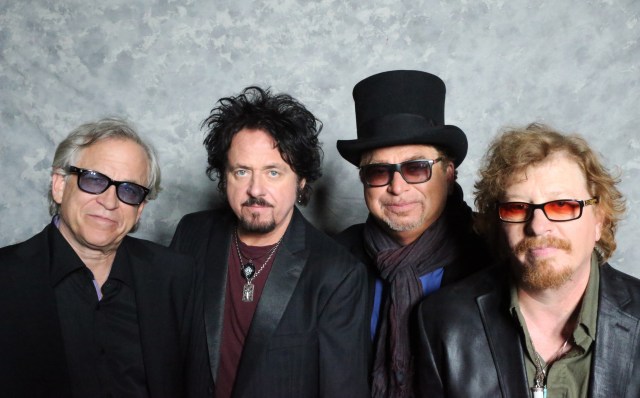
The current Toto’s core four: Steve Porcaro, Steve Lukather, David Paich, and Joseph Williams. Photo courtesy of SKH Music.
This is a piece I did last summer on Toto and Steve Lukather – just in time as they are about to embark on another jaunt across the country!
‘Tis the season of summer, which also means it’s the time of the year for the increasingly popular Classic Rock Package Tour.
It really is a win-win for both sides. Fans get to see two or three like-minded acts from the same era on the same bill, bands get to play for larger audiences, and maybe – just maybe – create some new fans. And sell more post-show Greatest Hits CDs in the process.
Still, Toto guitarist/singer Steve Lukather knows that his band’s co-bill with prog rock giants Yes might raise some eyebrows among the latter’s exacting (and, assumedly, brainy) acolytes.
“I know some people are going ‘I don’t know. Toto with ‘Rosanna’ and ‘Africa?’ Is this shit going to work? I fucking hate ‘
Africa!’” he says, in mock voice of disgust.
“But if you go deeper into our catalogue, you’ll find there’s a little bit more to it, and the [bands] are a lot closer than you think. All of us love prog rock, and bands like Gentle Giant. And some of us have worked with those guys from Yes before, so there is a connection. [Yes guitarist] Steve Howe is a huge influence on me. I used to line up to buy tickets to see those Yes tours when I was in high school.”
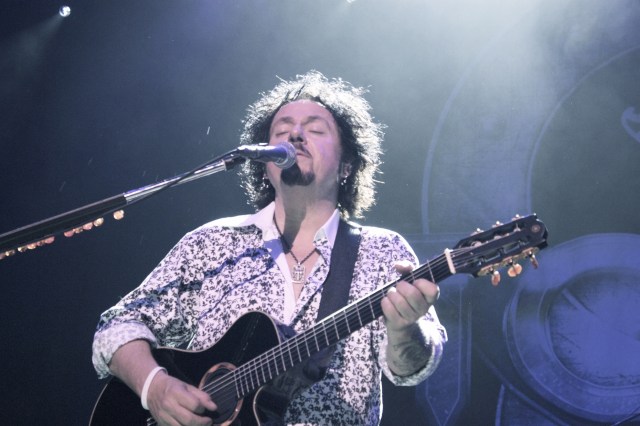
Lukather in full flight. Photo courtesy of SKH Music.
And, indeed, Lukather is right. For while best known for ‘70s/’80s hits like “99,” “Hold the Line,” “I Won’t Hold You Back” and – yes “Rosanna” and “Africa,” a deeper listen to their catalogue shows more proggy material.
The current lineup includes original members Lukather, keyboardists David Paich and Steve Porcaro, and – returning after many years away – original bassist David Hungate. Along with Joseph Williams (vocals), Shannon Forrest (drums), Lenny Castro (percussion) and two backup singers.
The band of well-versed studio and stage musicians came together when several of them worked with Boz Scaggs on the Silk Degrees record (with Paich co-writing much of the record) and subsequent tour. “I was 19 when I went on that tour! If it wasn’t for Boz, there probably wouldn’t be a Toto,” Lukather says. Deciding to form a band, they released debut Toto in 1978.
Earlier this year, the band dropped Toto XIV – their first studio effort in nearly a decade. And indeed, the tracks sound more prog than pop, with a surprising number tackle social and political issues (and the occasional power ballad).
The 57-year-old Lukather says that it’s not what the band consciously set out to do, but speaks to the evolution of, well, their lives.

“Imagine us! Older men wanting to talk about something beside getting high and going to the club and getting girls. We’ve lived through all that shit already!” he offers.
“We didn’t set it up to get topical, but it happened. You wake up, get a cup of coffee, turn on the computer and, boom! The bad news begins!” he says. “We’ve lived through death, destruction, divorce, children, various addictions, and we are still here. So we write about what’s going on now, not just goofy lyrics to wrap around guitar solos. Which we have done in the past!”
One of the record’s key tracks is “Holy War,” whose subject matter is not exactly hidden. Nor is Lukather’s distaste for its presence and provocateurs.
“We live in Dick Cheney’s world where war is money and destruction of people is good. I mean, the war in Afghanistan. Has anybody ever one that? Why do we keep slamming our heads against the wall?” he says.
“I don’t think if Jesus came down from the sky and looked at he world right now he’d be very pleased at what is going on. He’d be like, ‘what the fuck are you guys doing down there?’ And that’s non denominational.”
For the song “Unknown Soldier (For Jeffrey),” Toto turns its attention toward the after effects of conflicts and the people caught up in them. And while Lukather says he is squarely on the “peace and love” side of things, he does hail from a military family with an ex-Marine father and uncle who served in Vietnam.
“I saw what war did to my uncle. He was a hopeless alcoholic because of what he saw over there,” Lukather says. “I have the deepest respect for our troops who serve us. But I wonder what the end result is sometimes.”
Finally, the sometimes sorry state of Planet Earth also gets attention in “Running Out of Time.”
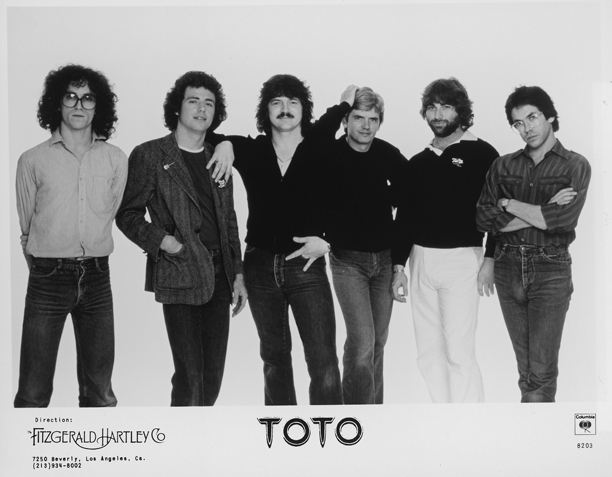
Toto in 1982: Steve Porcaro, Steve Lukather, Bobby Kimball, David Hungate, David Paich, and Jeff Porcaro.
“I live in California, where we have a really gnarly drought and they still have money for trillions of gallons of water for fracking,” he says, voice rising into sarcasm. “Fracking on a fault line where there are nuclear plants next to the ocean…just seems like a bad idea to me. What could possibly go wrong?”
At one point in their career, Toto was almost a brother act, boasting not only Steve Porcaro, but two of his siblings: Jeff on drums, and Mike on bass.
Jeff Porcaro died in 1992 at the age of 38 after spraying insecticide at his home—though there is much discrepancy between family, band members, and the official coroner’s report as to the actual cause or causes. Mike passed in March of this year from the affects of ALS, years after retiring from the group in 2007 upon being first diagnosed with the disease.
Lukather was with Porcaro the day before he died, and the situation has been the catalyst for a lot of reflection on his part.
“Mike used to say ‘I’m melting,’ and it was hard to watch somebody go through that. He could barely suck in some air to breathe the last time I saw him. ALS is the most cruel, horrendous, and vicious disease,” he says.
“And his poor parents. And Steve and his sister. To have two brothers die from the same family? That’s not supposed to happen. I have four kids, and if I had to bury two of them, I’d never smile again. But nobody wanted him to suffer anymore. You wouldn’t do that to an animal, much less a human being.”
So Lukather takes the tack of keeping the literal band of brothers’ music going both with Toto and his inclusion playing group’s hits with Ringo Starr and His All-Star Band (as he did last October at the Woodlands Pavilion).
After the current Yes/Toto show wraps up, Lukather will join Ringo for more touring this fall, followed by an overseas trip with Toto. Asked what it’s like performing every night with the now 75-year-old Beatle, Lukather still gushes like the teenaged Fabs fan he once was.
“I really love that man. I’m so happy for all the goodness in his life, and I’m a better person for knowing him. The Beatles are why I play music and I have also played with Paul and George. So it’s come full circle,” he offers.
“But sometimes I forget! I turn around and go ‘oh, that’s RINGO playing drums. He’s everything you would want him to be and more.”
As for Texas, Lukather has “fond memories of insanely beautiful women” and notes he had “outrageous parties” in the state. Though is also quick to point out, as a “reformed” person, won’t be partying like the old days this time around.
And while this interview was conducted before the death of Chris Squire, the sole remaining original member of Yes, he feels that the band’s fans will nonetheless click during each of their respective 90-minute sets.
“Some of our fans are going ‘what the fuck?’ And some of their fans are going ‘what the fuck?’” He sums up. “But think we’re both going to win over each other’s respective crowds. Especially if they come with an open mind.”
This article originally appeared in The Houston Press.

Photo by Sean Hagwell/Courtesy of Eagle Rock.
John Oates has a lot to love about his career these days. Long after their records made regular appearances on the Top 40, Hall & Oates maintain an enthusiastic fan base and sell out shows.
Last year saw the release of Daryl Hall & John Oates: Live in Dublin, a DVD/2CD package of a July 2014 gig at the historic Olympia Theatre. The concert was also recently shown in theaters across the country.
And while both had played the Land of Erin as solo artists, this was amazingly their first visit to the island as a duo.
“There’s not a lot of firsts in the Hall & Oates career at this point, and this was such a legendary venue. And we knew the [Irish] fans would be happy to see us,” Oates says. “The show sold out in an hour, and we wanted to document it.”
Of the 15 numbers, 11 will be familiar to anyone who owns the duo’s Greatest Hits CD (i.e. “Maneater,” “She’s Gone,” “Sara Smile,” “Rich Girl,” “You Make My Dreams,” “Kiss On My List,” and “Private Eyes”).
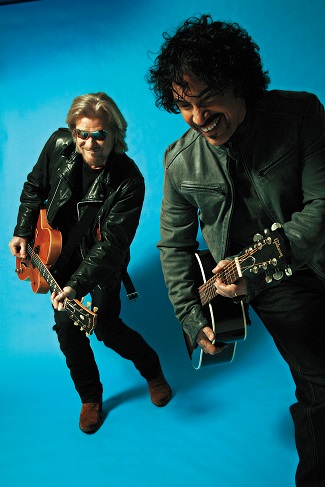
Photo by Mick Rock/Courtesy of Eagle Rock
But it also included a number of older, deeper cuts like “It’s Uncanny,” “Do What You Want, Be What You Are,” and “Las Vegas Turnaround” – the last a rare track in which Oates takes lead vocals. He says they try to balance their set list to please everyone.
“We have a professional responsibility to play the hits, and we’re proud of them. They’re still popular because they’ve stood the test of time,” Oates says. “But it’s one of our problems – we have too many hits and we can’t play them all. Though it’s a problem that a lot of groups would love to have.”
Oates says he would love to do a tour of nothing but deep cuts for hardcore fans – possibly in smaller venues. But he admits it might be a tough sell.
“We have over 400 songs together, and there is some amazing music that people aren’t familiar with,” he adds. “And it’s part of the long range plan. I’m pumped up about that idea.”
Watching Live in Dublin, one really gets the notion of just how important the saxophone is to the music of Hall & Oates. And since the mid-‘70s, those sounds have come from the mouth of Charlie “Mr. Casual” DeChant.
With his long gray hair and beard, he stands in striking physical contrast to the rest of the backing band, all far younger. Oates says there is both a peace and familiarity to having him onstage and in the studio.
“He’s the only surviving member of our ‘70s band. I’m very aware of [his presence] and take special notice of our moments on stage, especially since he stands near me and we interact a lot,” Oates says.
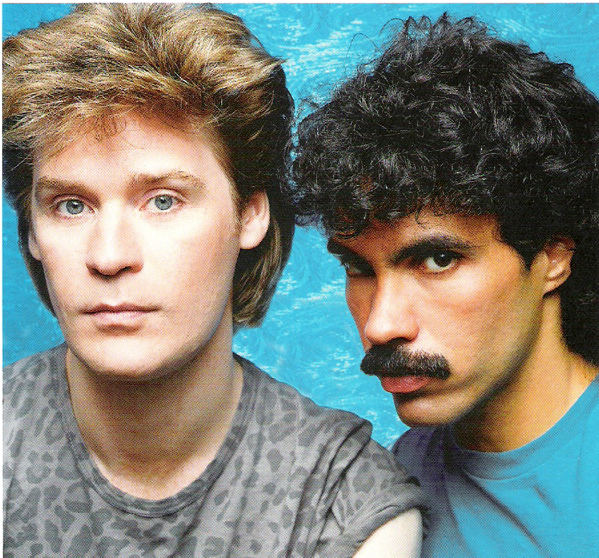
Hall & Oates in their peak commercial period. Oates’ mustache went on to pop culture fame of its own.
“I look at him through the lens of the fact that every moment with Charlie is special, because someday he might not be there. And I think of that with Daryl too. But we have a young band that brings passion and excitement to the old material, and it’s really kicked Daryl and me in the butt!”
Hall & Oates had been eligible for the Rock and Roll Hall of Fame since the late ‘90s, and were inducted in 2014 after their first appearance on the ballot. Oates says he wasn’t losing over any sleep over not being in, and that the band’s fans felt it was a bigger issue than he did.
“They were honoring us for a lifetime of achievement in pop success, and that’s great and it’s been nothing but positive being in there,” he says.
But in fact, both Hall and Oates maintain healthy solo careers outside of their two-man act, Hall most noticeably with the “Live From Daryl’s House” podcast and now television series.
In 2014, Oates released his fifth solo record (Good Road to Follow), and more recent, a guest-studded live concert TV special/DVD (Another Good Road). Both showcase Oates’ singing and guitar playing, covering lot more diverse genres of musical than casual fans have heard.
“I’m [best] known for my pop work with Daryl, which is perfectly understandable. But I had a whole musical life before I met him when I was 18. I started playing guitar at six, and I was always into traditional American music like folk, blues, and bluegrass,” he says.
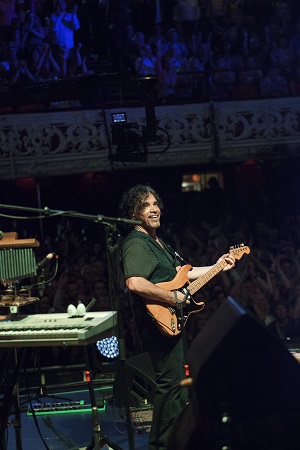
Daryl Hall & John Oates playing their sold out show at the Olympia Theatre on Tuesday, 15 July 2014. Photo by Kathrin Baumbach/Courtesy of Eagle Rock
“So I’ve gone back to my influences like that in my solo career, and it’s great to be in that world. I wanted to extend the life of the project with Another Good Road. The band was great, and I even put some newer songs in there.”
Of course, it’s the older, soundtrack-of-your-life songs that keep concertgoers buying tickets to Hall & Oates shows. Songs which often first came to their fans’ attention first via a seemingly ubiquitous presence on MTV.
The duo’s videos – in which their backing band also got appearances – often were fun to watch and must have been even moreso to film. Though John Oates has another view.
“I am going to be brutally honest, I didn’t care for any of those videos. I never wanted to be an actor, messing around in stupid costumes in front of a curtain,” he says.
But a “perfect storm” of a new video channel needing content and bands looking for non-radio exposure, made the relationship between media and musicians symbiotic.
When pressed, Oates says his least-cringeworthy video is for the song “Out of Touch” because it was “so weird and over the top.”
“I’m not a nostalgic person who lives in the past. I’m way more interested in writing new songs and doing new things,” Oates sums up. “And I have so much positive stuff going on right now, I can’t absorb it all!”
A version of this interview originally appeared in The Houston Press.

Randy Bachman today. Photo by Mike Hough.
In his career as a co-vocalist/guitarist/songwriter for not one but two pretty successful classic rock bands (The Guess Who and Bachman-Turner Overdrive), Randy Bachman has sold tens of millions of records, sold out concerts, and hit the top of the charts.
But, according to his son, singer/songwriter Tal Bachman (who had a hit of his own in 1999 with “She’s So High”), dad didn’t really make it in the music biz until he became animated in a 2000 episode of “The Simpsons.” It’s where Homer loudly requests the band play “Takin’ Care of Business” and “You Ain’t Seen Nothin’ Yet”…and continues to bellow for the tunes after the band has obliged.
“A lot of other musicians had been on the show. Matt Groening went to college near Seattle, and that was the town where B.T.O. first broke, so he was a fan,” Bachman recalls today.
“So he wanted to animate me and [B.T.O. co-vocalist/bassist] Fred Turner. It was a lot of fun, and they treated us like royalty. Matt even sent a huge box of ‘Simpsons’ stuff, and sent Fred and I an autographed cell afterward.”
Bachman’s cartoon legacy makes for an interesting story, but it’s not one that he tells on the recent DVD, Randy Bachman Vinyl Tap Tour: Every Song Tells a Story. Part concert, part interview, and part documentary, it features Bachman weaving tales of his life and career while he and a band play excerpts from 14 of his biggest songs as he tells the stories behind their creation.
Filmed in his hometown of Winnipeg, Canada on the last date of a tour, it combines Ray Davies’ Storyteller format with aspects of Bachman’s own Canadian radio program, “Vinyl Tap.” Throughout, vintage pictures and video clips play on a screen behind him.
“I haven’t even seen it because I am always facing forward, so I don’t know what they’re showing behind me!” Bachman laughs. “And the format certainly beats standing up at 2 p.m. in the heat playing a pop festival.”
Today, music fans take it for granted they can get pretty much every song every recorded immediately at the click of a mouse. But in early ‘60s Canada, Bachman and future Guess who co-vocalist/keyboardist Burton Cummings relied on painstakingly taped compilation reels of American and English rock music sent to them each Christmas by one of Bachman’s family members.

Homer Simpson Loves ’em! – BTO: Fred Turner, Robbie Bachman, Randy Bachman, and Blair Thornton.
The pair (and other bandmembers) would learn as many of the songs as possible to play themselves at gigs, as well as buying what they could.
“New albums cost $3.98. So Burton and I would save up money from gigs or throwing newspapers and pitch in $2 each. One of us would get possession of the record for a week, and then give it to the other,” Bachman remembers.
“And we’d learn every groove, every lick, and every lyric on both sides. Chuck Berry and Bo Diddley stuff. We even knew the names of the producers!”
One of the more interesting aspects about the DVD is how many of Bachman’s songs that classic rock listeners know and love by heart came about as flukes.
The Guess Who’s “American Woman” was born from an impromptu stage jam with lyrics invented on the spot about the Canadian band’s desire not to be drafted in the U.S. Army. “No Sugar Tonight” was what Bachman heard a San Francisco biker mama tell her man-who-turned-into-a-mouse what he would be getting from her later.
B.T.O.’s “Takin’ Care of Business” had a similar musical origin, with lyrics drawn from words Bachman wrote years before about a blind engineer who commuted to the studio on the train. Originally called “White Collar Worker,” it took on the more familiar title from the tagline of a Canadian DJ. “You Ain’t Seen Nothin’ Yet” was an after-hours goof off performed as a playful poke at Bachman’s stuttering brother.
“I could sit down with a rhyming dictionary and a thesaurus and try to sound like a great songwriter, but’s it’s contrived,” Bachman says. “But when you let it go, something happens. It’s a ball of energy that comes from the Angel of Song.”

The music of both the Guess Who and Bachman-Turner Overdrive – as well as his solo work – fall into the category of that sort of blue collar “meat and potatoes” rock of the ‘70s. Think Bob Seger, Grand Funk Railroad, Foghat, and the James Gang.
And while the genre doesn’t get critical respect (saved, it seems, for prog-rock bands with intricate instrumentation who write about space like Pink Floyd and King Crimson), Bachman is nonplussed.
“It’s all just music. I mean, Burton and I started out playing classical music. And country music today is basically classic rock. All of them are playing Les Pauls through Marshall amps!” he says. “Lots of people don’t own up to liking meat and potatoes thumping rock. But if you get them at a party, they’ll want to hear ‘Takin’ Care of Business’ and ‘Old Time Rock and Roll’ and will sing along!”
Randy Bachman’s plans for the next year will keep him busy. He’s touring (some gigs with the “Vinyl Tap” format, which hopes to bring to the U.S.). He’s also recorded a blues record with a female drummer and bassist (“They sound like the Who in their prime!”) with producer Kevin Shirley called Heavy Blues. There have also been occasional gigs with B.T.O. partner Fred Turner and Peter Frampton’s Guitar Circus.
“I’m having the time of my life recycling myself and reinventing myself over and over, doing things I thought I couldn’t do again in terms of songwriting and singing,” he says.
And who knows? Maybe Randy Bachman will someday, somewhere, somehow overhear a snippet of your conversation and turn it into a classic rock hit. Homer, are you listening?
A version of this article originally appeared in The Houston Press.
 | zumpoems on New Book Celebrates Paul McCar… |
| Johnny Winter's… on Johnny Winter Stays True to th… | |
| Jerry Konkel on John Kay: A Wolf Goes Solo… | |
| 12 Classic Rock Arti… on Boogie & Blues Rockers Fog… | |
 | Dexter Wright, Balti… on Why Can’t They Be Friend… |

Purchase "The Classic Rock Bob Reader" w/ 130 interviews on Amazon.com

Purchase the WAR bio "Slippin' Out of Darkness" on Amazon.com!

 Classic Rock Bob